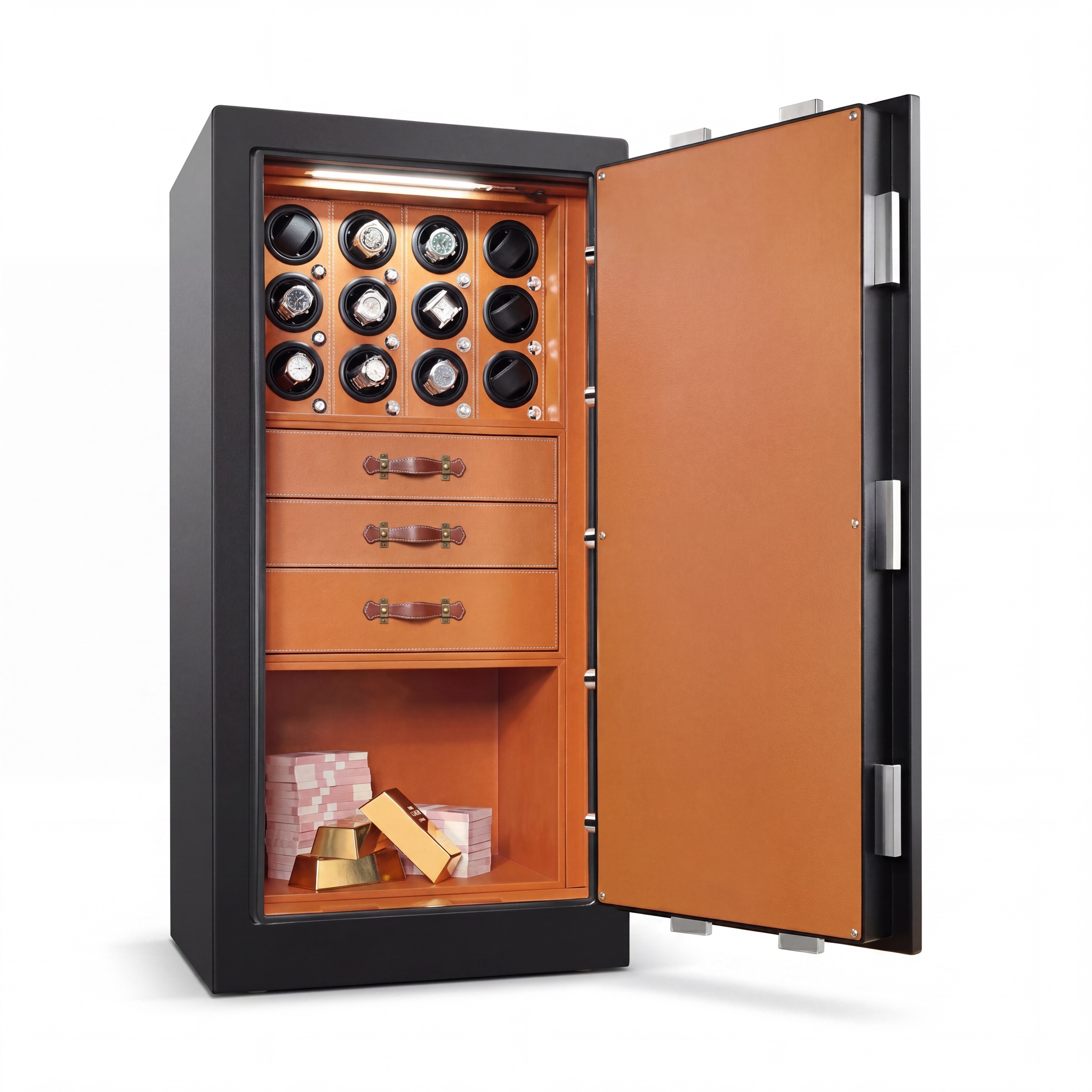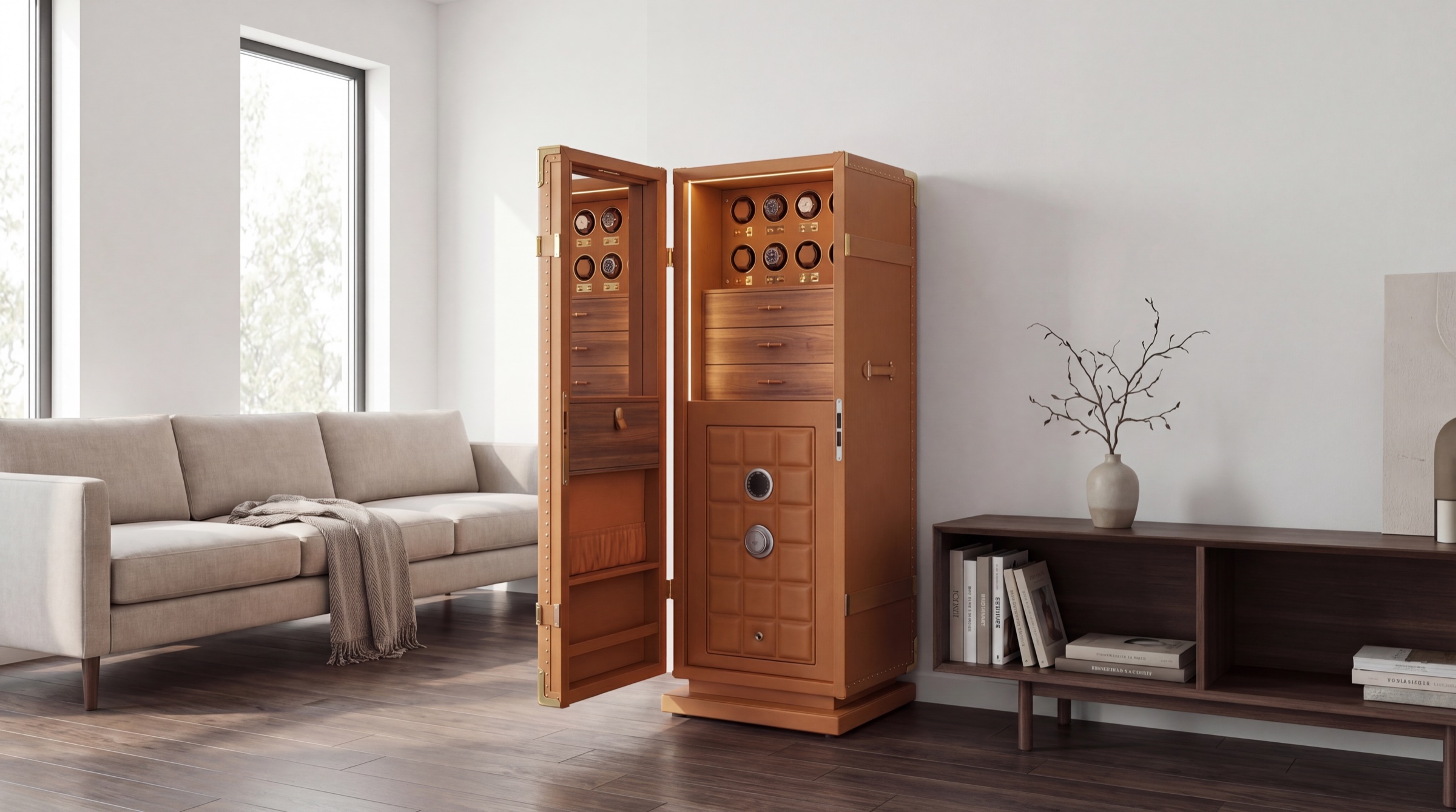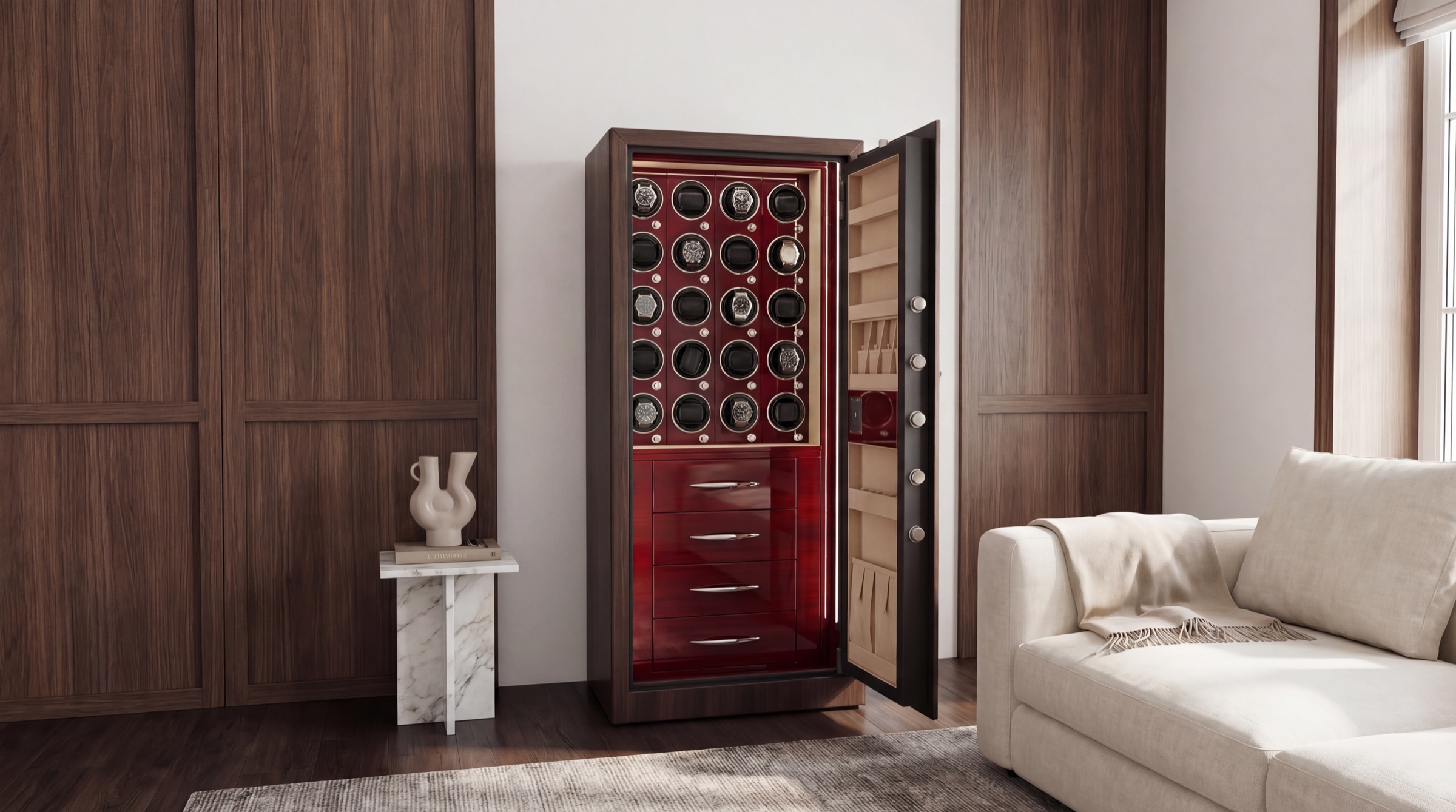
Whether a freestanding watch safe or a built-in watch safe is right for you comes down to weight, wall construction and the security grade you need: a freestanding safe can be installed in almost any room, heavily anchored and built to high EN 1143-1 grades, while a recessed watch safe disappears discreetly into solid masonry but demands a load-bearing wall and deeper installation planning. For most collectors the freestanding safe is the more flexible and secure choice — the built-in version earns its keep when discretion and space-saving come first.
Both watch safe types can be beautifully made, properly certified and fully insurable. The honest difference is not the protection level alone, but how and where you live — and how visible you want your collection to be. This comparison sorts out the criteria that genuinely decide it in practice.
A freestanding watch safe is a self-contained body that stands on the floor and is ideally anchored into the floor or rear wall. A built-in watch safe is recessed fully or partly into a solid wall, so only the door remains visible — often hidden behind a mirror, panelling or a wardrobe.
The freestanding safe wins on weight and full material thickness all around. The recessed safe wins on invisibility: what no one sees rarely becomes a target. Our Standard Safes are designed as freestanding bodies, while the Grand Cabinet can be integrated into a niche or wall on request.
Security is defined not by freestanding versus built-in, but by the resistance grade under EN 1143-1 (Grade 0–VI, measured in resistance units, RU) and by how the safe is anchored. A freestanding body can be made to any grade because its walls bear the load independently of the masonry.
A built-in safe gains extra security from the surrounding masonry, which makes attacks on the sides and rear far harder — provided the wall is solid and the safe is correctly cast in. In stud or lightweight partition walls that advantage disappears.
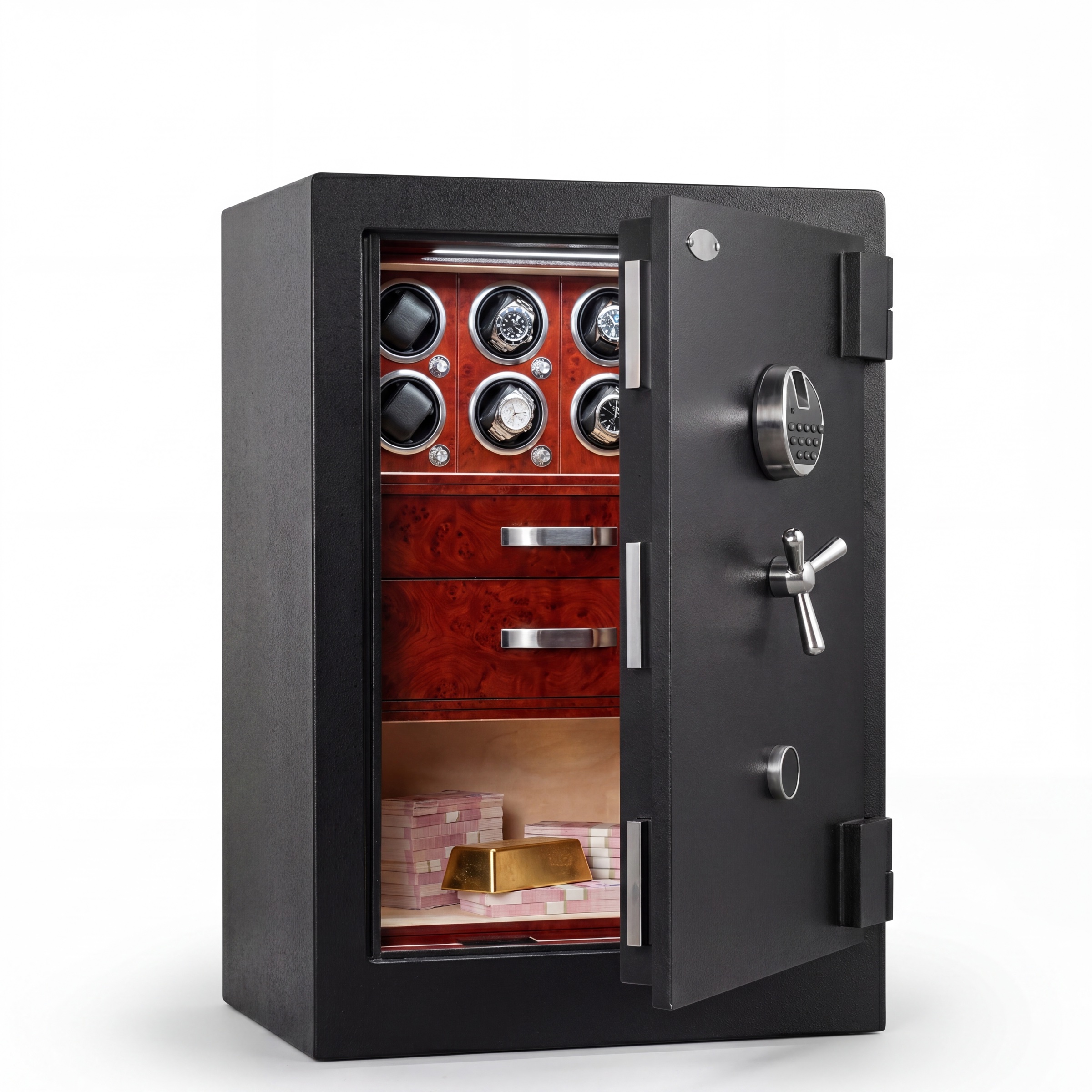
A quality watch safe weighs roughly 200 to 600 kg. With a freestanding model that mass is an asset: it makes the safe hard to carry off, and floor anchoring can be executed cleanly. On upper floors, however, you should check the floor's load capacity first.
A built-in safe transfers part of its weight to the load-bearing wall, but requires a correctly sized wall and a prepared recess. Both versions benefit from professional fixing — there is more in our guide to weight and anchoring.
The safe itself costs about the same in either form; the difference lies in the building work. A freestanding safe is often ready to use on delivery, whereas the built-in route involves masonry, chasing and casting work.
"It is not the type of safe that protects your watches — it is the certified grade and a clean anchoring."
The table below summarises the criteria that actually matter in an honest watch safe comparison.
| Criterion | Freestanding watch safe | Built-in watch safe |
|---|---|---|
| Discretion | visible as furniture | almost invisible |
| Building work | low — place & anchor | high — niche, casting, solid wall |
| Security | full grade all around | grade plus masonry protection |
| Weight/structure | 200–600 kg on the floor | partly carried by wall |
| Flexibility if you move | high | low (permanently fitted) |
| Insurance grade | EN 1143-1, VdS/ECB·S | EN 1143-1, VdS/ECB·S |
At Kronberg Collection a freestanding safe becomes a piece of furniture: exterior in any RAL or Pantone lacquer, leather-wrap or wood veneer, with interiors in full-grain leather, Alcantara or velour in navy, cognac, cream, forest green or black. It settles into a dressing room or living space rather than disrupting it.
A built-in safe, by contrast, vanishes entirely behind panelling or a mirror. You can explore both routes in the configurator, and the collection shows how security and design come together.
Decide by your living situation: if you rent, move often or lack a suitable solid wall, a freestanding watch safe is clearly the better fit. If you own and are building or renovating and want maximum discretion, the built-in watch safe pays off.
In both cases capacity and grade should match your collection — the reasoning is in our guide on how to choose a watch safe. For a personal assessment, reach our atelier near Zürich on +41 44 974 27 19 or via the contact page.
Not automatically — security is determined by the EN 1143-1 resistance grade, not the safe type. A built-in safe gains extra protection only when it is properly cast into a solid wall; in lightweight partition walls that advantage is lost.
Yes, a quality freestanding safe is anchored into the floor or rear wall, which greatly improves theft protection given its 200–600 kg weight. Professional anchoring is part of Kronberg Collection's professional installation.
You need a load-bearing solid wall of concrete or masonry with enough depth for the safe to be cast in. Stud or lightweight partition walls are unsuitable, as they neither carry the weight nor add meaningful protection.
For insurance cover it is the certified EN 1143-1 resistance grade plus VdS or ECB·S certification that matters, not whether the safe is freestanding or built-in. Cover limits rise with the grade.
The safe itself costs much the same in either form; Kronberg Collection's freestanding Standard Safes start from CHF 12,900. The difference is the building work, since a built-in installation also requires masonry, chasing and casting.
Book a no-obligation personal consultation with a Kronberg advisor. We'll guide you through every option.