A safe is only as good as its certification. This is not a marketing proposition — it is a legal and actuarial reality. When your insurance company asks which grade of safe you have, they are asking a specific, technical question. When they process a claim, they will verify the answer. Getting this wrong does not mean your claim is complicated. It means your claim is denied.
The EN 1300 standard is the European benchmark for safe burglary resistance. It is administered by independent testing laboratories and covers the construction, materials, attack resistance, and locking mechanism of every safe that bears its certification. Understanding it clearly is the first responsibility of any serious collector.
EN 1300 is not a single test but a battery of them. Certified laboratories attack safes with professional tools — grinders, drills, levers, thermal lances — and measure how long the safe resists. The testing is conducted against both the door and the body of the safe. The standard also evaluates the quality of the locking mechanism, the anti-manipulation resistance of the lock, and the structural integrity of the hinges, bolts, and body under sustained attack.
The result is a grade — I through VI — with each grade corresponding to a resistance time under specified conditions and a cash or valuables equivalent that the safe is deemed to protect. Insurance companies use these equivalents directly in their policies. A Grade II safe does not "feel" safer than a Grade I — it demonstrably is, by a defined margin, tested in a laboratory and certified by an independent body.
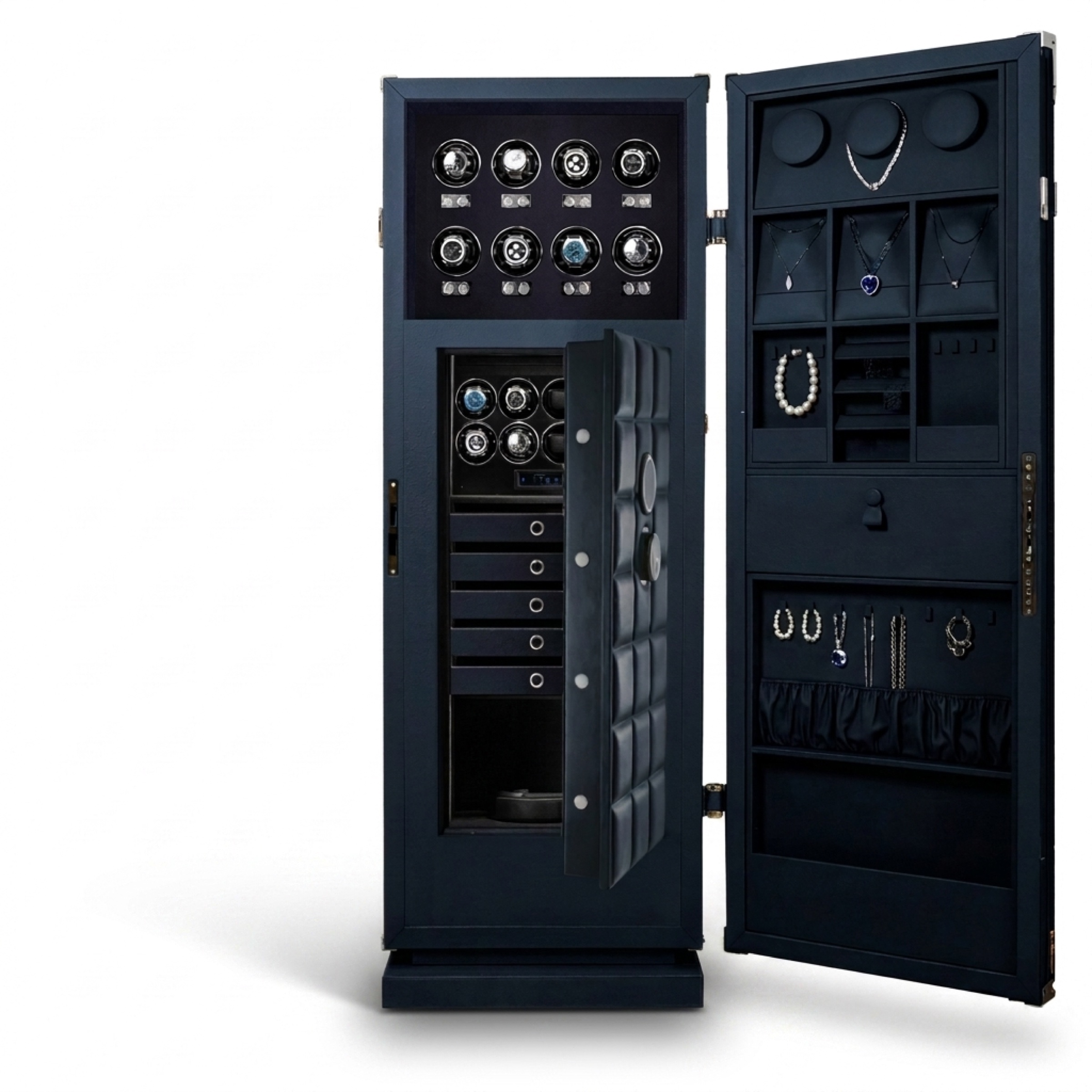
A Grade I safe is certified to protect up to approximately EUR 10,000 in cash or EUR 100,000 in jewellery and valuables. For watch collectors, the jewellery equivalent is the relevant figure, and in Swiss insurance practice this typically translates to approximately CHF 100,000. Grade I safes have a minimum door thickness of 10 mm and body thickness of 3 mm in equivalent steel.
Grade I represents the minimum meaningful certification for any collector. An uncertified safe — regardless of how heavy or impressive it appears — offers no insurance protection whatsoever. Many collectors are surprised to learn that the imposing metal cabinet they purchased online carries no certification and is treated by their insurer as equivalent to a locked drawer.
Grade II safes are certified to approximately EUR 30,000 in cash or EUR 300,000 in jewellery equivalents — approximately CHF 300,000 in Swiss insurance practice. Door thickness increases significantly, with more robust bolt work and enhanced locking mechanisms. The attack resistance time at Grade II is substantially higher than Grade I.
For most serious watch collectors — those with collections in the range of CHF 100,000 to CHF 250,000 — Grade II represents the right balance between cost, size, and protection. It is the grade most commonly specified by Swiss insurers as a minimum for valuable collections held in residential properties.
Grade III certification covers approximately EUR 80,000 in cash or EUR 800,000 in jewellery — approximately CHF 800,000 in Swiss insurance terms. At this grade, the construction becomes substantially more robust: thicker steel, more complex bolt work, and locking mechanisms that resist even sophisticated attacks. Weight increases accordingly; a Grade III safe in our 120 cm Standard model weighs in excess of 400 kg empty.
Grade III is typically specified for collectors with watches of significant individual value — Patek Philippe grand complications, Richard Mille, A. Lange & Söhne — or those with collections exceeding CHF 500,000. It is also increasingly required by specialist watch insurance providers as a condition of premium coverage.
Grades IV through VI exist for institutional use — bank branches, high-security archives, central banks — but are available on bespoke commission for private clients with exceptional concentrations of value. A Grade IV safe in residential configuration is a rare and highly specialised piece, requiring structural reinforcement of the room in which it is installed. We have produced Grade IV pieces for private clients; each is an entirely individual project.
The answer depends on your collection's current value and your insurer's requirements. As a general guide: Grade I for collections up to CHF 100,000; Grade II for CHF 100,000 to CHF 300,000; Grade III for CHF 300,000 and above. Always confirm the specific requirement with your insurer before commissioning — the certification requirement may also depend on whether the property is occupied during the night, the quality of the alarm system, and other factors.
EN 1300 covers burglary resistance only. Fire protection is a separate certification — EN 1047-1 — covering resistance to extreme heat and the survival of contents within a defined temperature threshold. A safe can hold a Grade II EN 1300 certification without any fire protection, and vice versa. Both can be combined, but the combination adds cost and weight. We will cover fire ratings in detail in a separate article in this journal.
Swiss home contents insurance (Hausratversicherung) typically covers valuables up to a defined limit without a specific safe requirement. But for collections of meaningful value — typically above CHF 30,000 — specialist valuables coverage requires a certified safe. The insurer will specify the minimum grade, and may also require the safe to be anchored (floor or wall bolted), fitted with an alarm output, and documented with an inventory and appraisal. Meeting these requirements is not a bureaucratic exercise — it is what makes a claim payable when it matters.
"Your insurance provider will ask which grade you have. Make sure you already know the right answer — and that you have the certificate to prove it."
| Grade | Cash Equiv. (EUR) | Jewellery Equiv. (CHF) | Min. Door Thickness | Min. Body Thickness |
|---|---|---|---|---|
| Grade I | Up to 10,000 | Up to ~100,000 | 10 mm | 3 mm |
| Grade II | Up to 30,000 | Up to ~300,000 | 30 mm | 5 mm |
| Grade III | Up to 80,000 | Up to ~800,000 | 50 mm | 8 mm |
| Grade IV | Up to 200,000 | Up to ~2,000,000 | 80 mm | 12 mm |
EN 1300 is the European standard for burglary resistance, under which independent laboratories attack a safe with grinders, drills, levers and thermal lances and measure how long it resists. It assigns a grade from I to VI, each tied to a defined resistance time and an insured cash or valuables equivalent.
As a general guide, Grade I covers collections up to CHF 100,000, Grade II covers CHF 100,000 to CHF 300,000, and Grade III is for CHF 300,000 and above. Always confirm the exact minimum grade with your insurer first, as it can also depend on your alarm system and whether the property is occupied overnight.
A Grade II safe is certified to approximately EUR 30,000 in cash or EUR 300,000 in jewellery, which Swiss insurers typically treat as roughly CHF 300,000 of cover. It has a minimum door thickness of about 30 mm and is the grade most commonly specified for valuable collections in residential properties.
They are two separate certifications: EN 1300 covers burglary resistance only, while fire protection is certified under EN 1047-1 for resistance to extreme heat. A safe can hold a Grade II EN 1300 rating with no fire protection at all, and the two can be combined only at extra cost and weight.
No, an uncertified safe offers no insurance protection and is typically treated by insurers as equivalent to a locked drawer, regardless of how heavy it looks. For Swiss valuables cover above roughly CHF 30,000 a certified safe is required, and the insurer may also demand that it be floor or wall anchored and documented with an appraisal.
Book a no-obligation personal consultation with a Kronberg advisor. We'll guide you through every option.