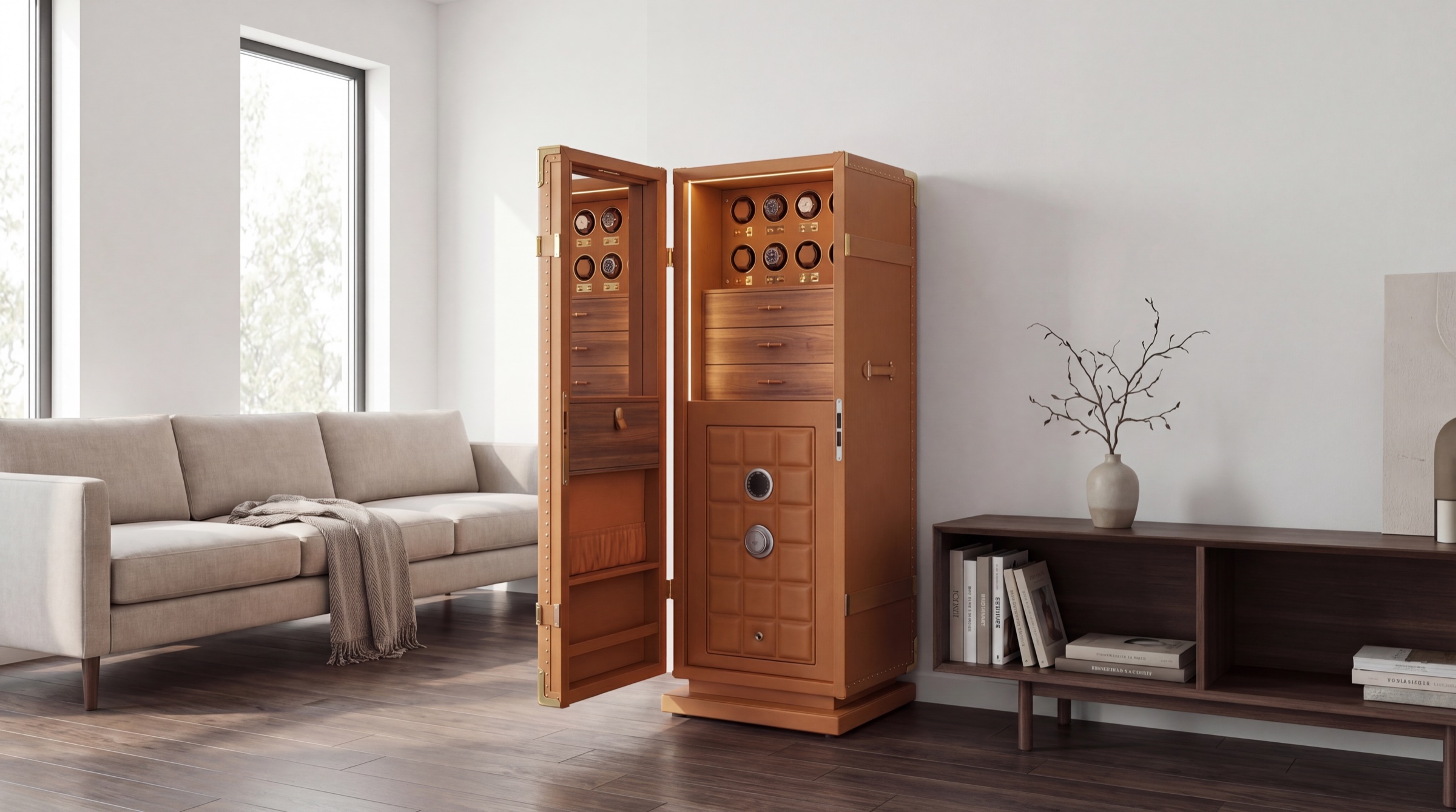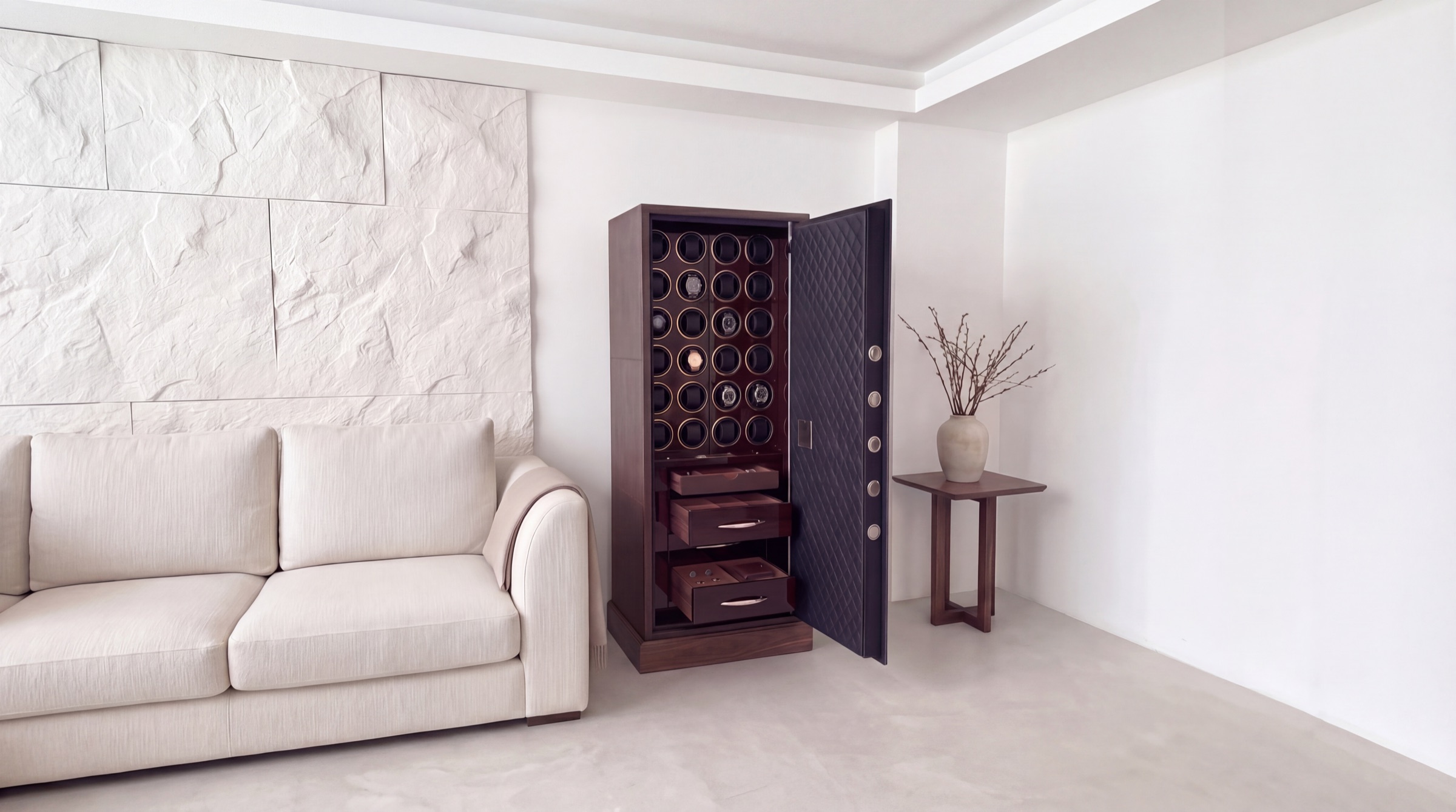
A watch safe in the walk-in closet is the most natural choice for most collectors: it sits where the day begins and ends, alongside the cufflinks, jewellery and the watches already living there. To make security and comfort coexist, the location, floor loading, anchoring and integration into the cabinetry must be planned from the outset. A bespoke safe weighing 200–600 kg and rated to EN 1143-1 can disappear completely into the joinery without surrendering any of its protection.
Most mistakes happen because the safe is an afterthought, considered only once the cabinetmaker has finished. Fix the recess, the power supply and the door swing early, and you avoid costly rework — and you end up with a security solution that reads as a deliberate part of the closet.
The walk-in closet usually sits in the private part of a home, away from the entrance and any rooms guests see. That discretion has real security value: a safe nobody knows about is far less likely to become the target of deliberate planning. At the same time, the short reach from the dressing room to the watch is the single biggest day-to-day convenience.
Climate is another quiet advantage. Closets tend to be temperature-stable and free of direct sun — ideal for leather straps and dials. Fit the safe with built-in winders and the collection stays wound and ready without the hum of a winder running in the bedroom.
A watch safe weighs roughly 200 to 600 kg depending on size and grade, and that mass rests on a small footprint. On a concrete slab in newer construction this is rarely an issue; in older buildings or upper floors with timber joists, have a structural engineer check the point load. Where there is any doubt, a load-spreading plate distributes the weight across several joists.
Anchoring is the second non-negotiable. Only a firm connection to the floor or a load-bearing wall turns a heavy cabinet into a burglary-resistant safe — otherwise it simply leaves with the contents inside. For the underlying reasoning, see our overview of the Standard Safe and our article on the watch safe as furniture.
| Standard Safe | Format (approx.) | Capacity | Weight (approx.) |
|---|---|---|---|
| Safe 85 cm | compact, 85 cm tall | up to ~30 watches / 12 winders | 200–280 kg |
| Safe 120 cm | mid, 120 cm tall | up to ~50 watches / 24 winders | 300–420 kg |
| Safe 170 cm | tall, 170 cm | up to ~75 watches / 40 winders | 450–600 kg |
The most elegant approach is cabinetry integration: the safe sits in a purpose-sized recess, flush with the wardrobe fronts, and disappears behind a sliding or hinged door in the same veneer. The detail that decides success is the door swing — the safe door must open fully without striking a drawer or hanging rail.
With a Grand Cabinet the question falls away entirely, because the housing is itself furniture-grade: an exterior in any RAL or Pantone lacquer, leather wrap or wood veneer, and an interior in full-grain leather, Alcantara or velour. The safe becomes part of the room rather than an intrusion into it.
"The best safe in a walk-in closet is the one a visitor never knows is there."
Three things should be settled before the joinery goes in: the exact location, a power supply for winders and lighting, and a clear path for delivery. A 500 kg safe will not pass through every staircase — logistics belong in the planning, not in the delivery week.
In a private home's walk-in closet, a certified EN 1143-1 resistance grade paired with an EN 1300-rated lock is the baseline. The grade you need follows the insured value of the collection — cover limits scale with the grade. VdS and ECB·S are the recognised European certification bodies, and their mark is usually the insurer's condition.
For collectors who treat their pieces as a store of value, it is worth reading why storage protects a watch's value as much as its movement.
If you want automatic watches kept running and ready to wear, integrate winders directly into the safe. Each module is individually programmable for turns per day (TPD) and direction, so every watch gets the right routine. Rarely worn pieces and leather-strapped watches are better left to rest in the climate-stable interior.
How many modules make sense depends on your wearing rhythm — a compact option like the 6-module winder covers most collections. When you are ready to plan concretely, our configurator helps, and for bespoke questions the atelier is reachable directly via the contact page.
Yes, provided the floor can carry the point load. With timber-joist floors or older buildings, have a structural engineer check the 200–600 kg weight; a load-spreading plate can distribute it across several joists.
The safe is bolted to the floor or to a load-bearing wall. Only this anchoring turns the heavy cabinet into a burglary-resistant safe, since otherwise it could be carried off with the contents still inside.
Yes. Kronberg Collection finishes the exterior in any RAL or Pantone lacquer, leather wrap or wood veneer, so the safe sits flush with the cabinetry and hides behind a matching door.
Only if you want integrated winders or interior lighting. In that case a discreet socket should be planned into the recess before the joinery is installed.
The deciding factor is the insured value of the collection, because cover limits rise with the EN 1143-1 grade. A certified safe carrying a VdS or ECB·S mark and an EN 1300-rated lock is the usual baseline.
A firmly anchored safe makes sense from just a handful of valuable watches. The compact Safe 85 cm holds up to around 30 watches and up to 12 winders and fits most dressing-room recesses.
Book a no-obligation personal consultation with a Kronberg advisor. We'll guide you through every option.