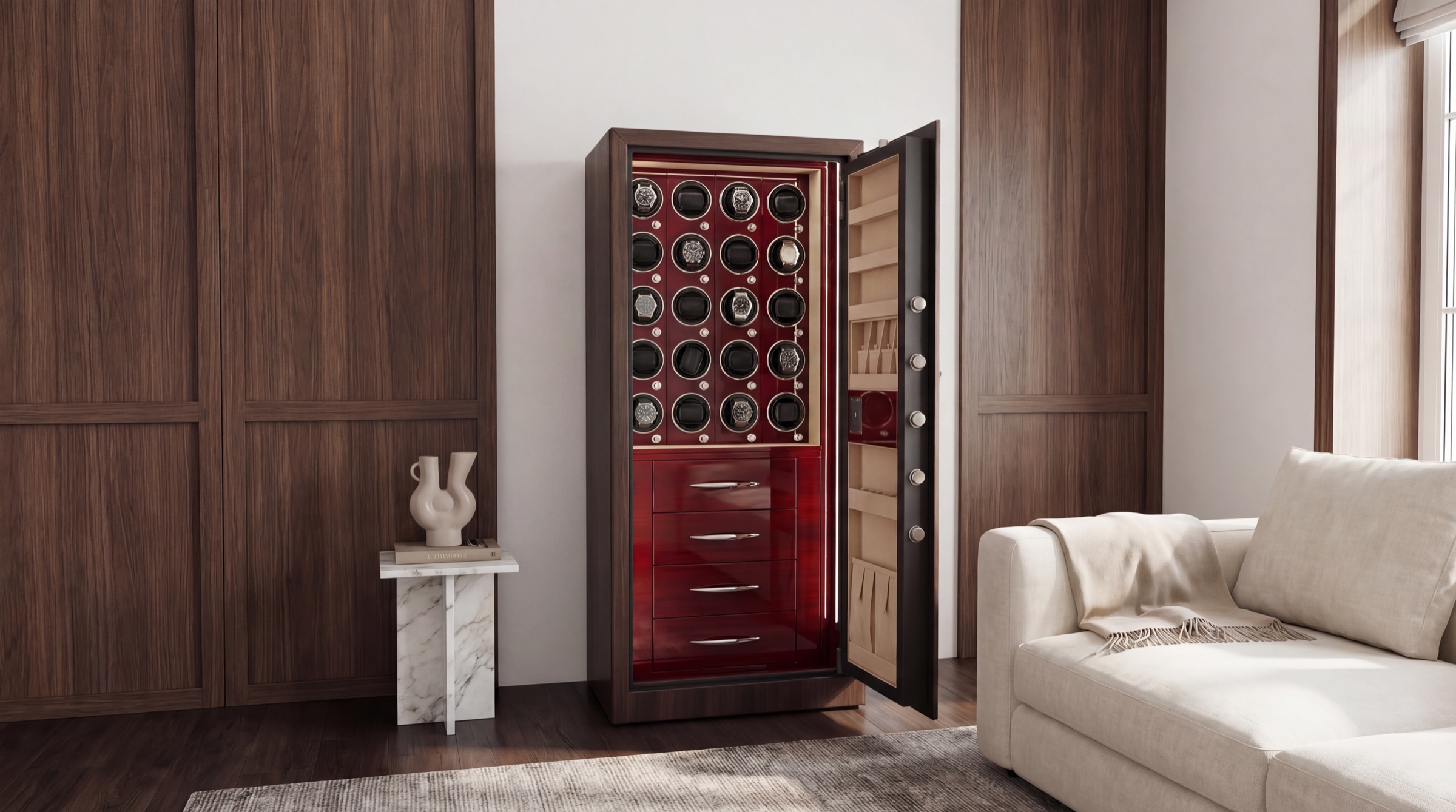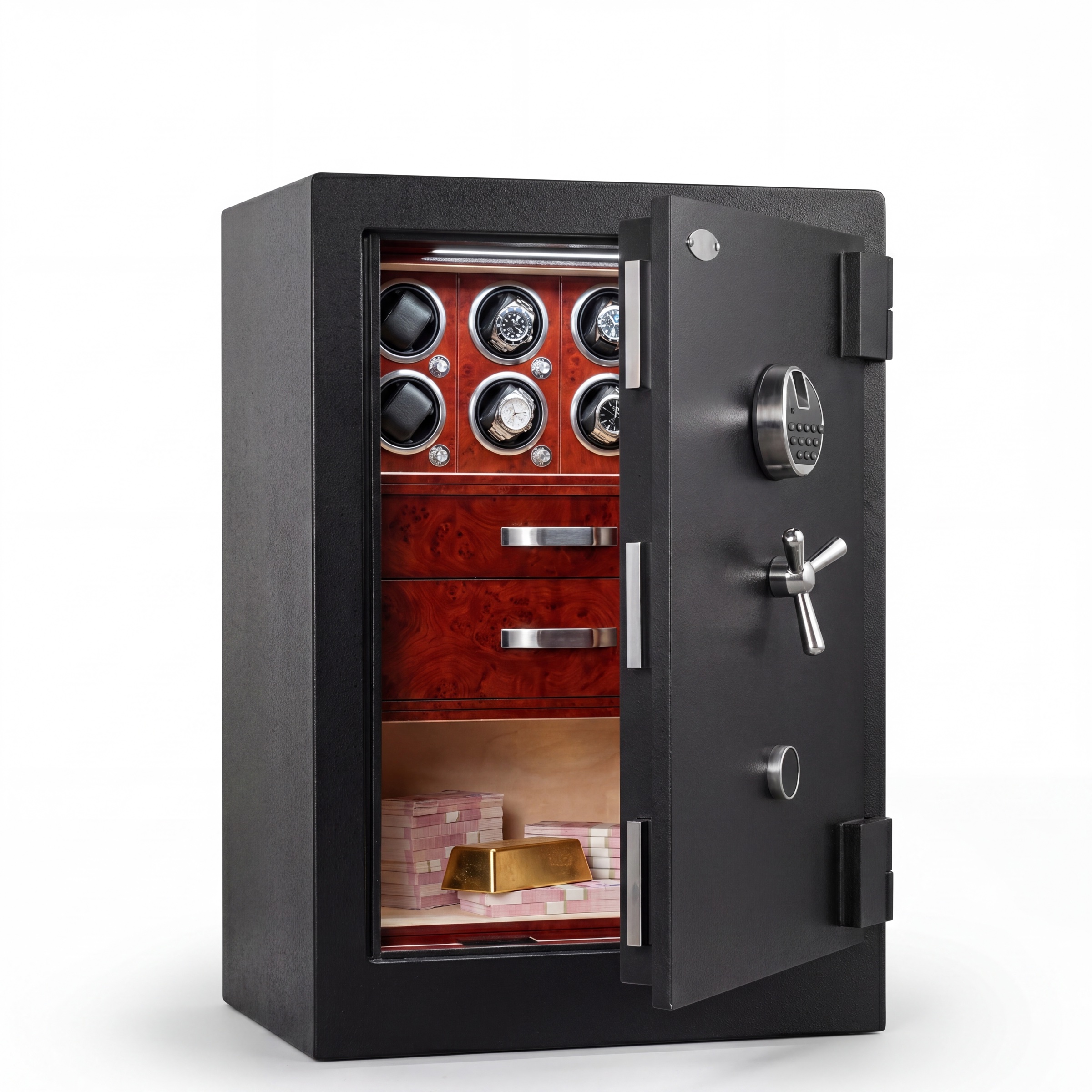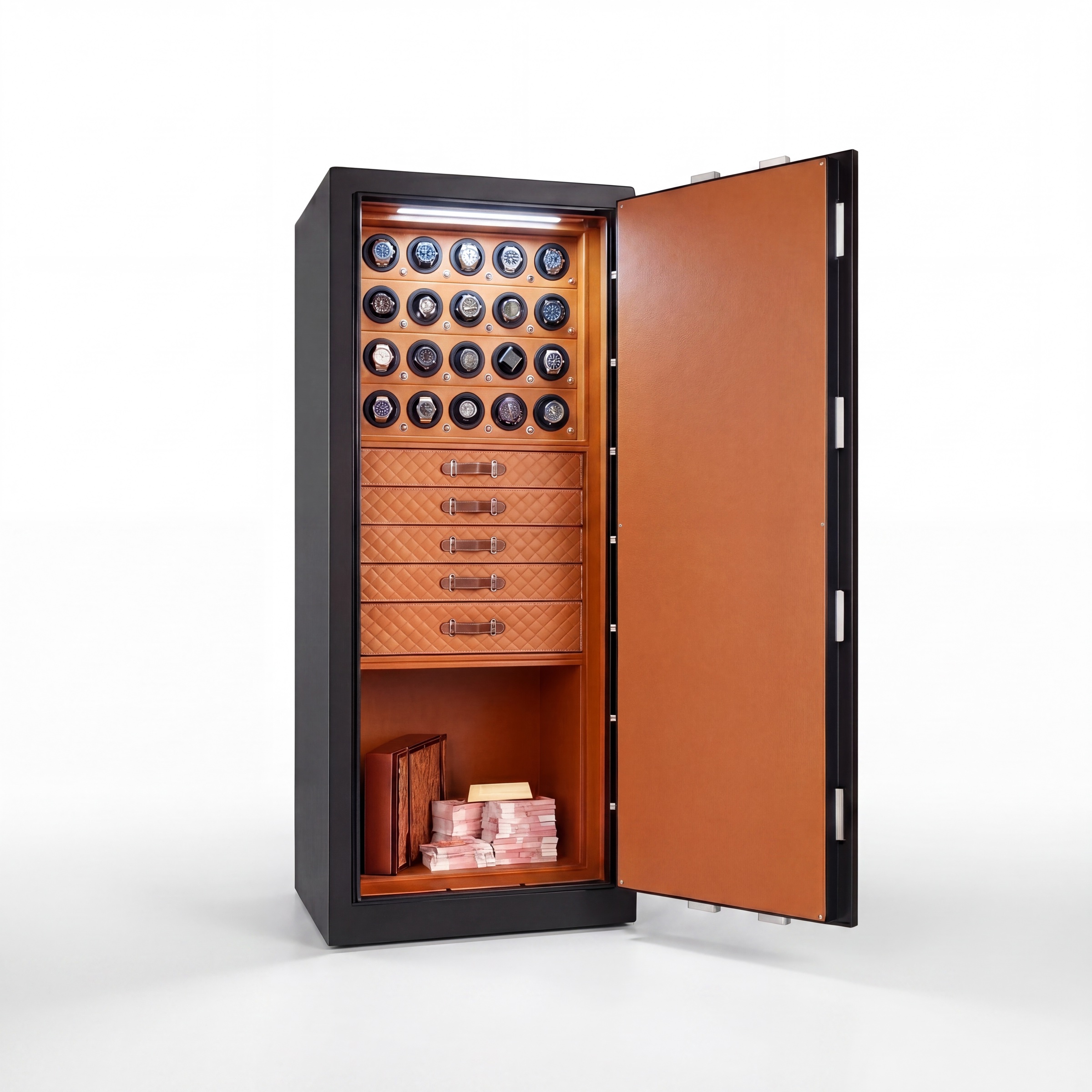
A wall-mounted watch safe is a unit recessed into masonry so it sits flush behind a picture, panelling or a closet niche — it draws its security from concealment and the surrounding wall rather than from its own weight. For smaller collections in a solid concrete or brick wall, an in-wall watch safe is an elegant, space-saving solution; for larger holdings or high insurance limits, a heavy anchored freestanding safe is often the better choice. What decides it is the wall type, the available recess depth, and the certified resistance grade under EN 1143-1.
At Kronberg Collection we build watch safes by hand in our atelier near Zürich. Before we ever specify a recessed watch safe, we settle the same three questions: what your wall can carry, how many watches need to fit, and what grade your insurer requires.
A hidden watch safe is set into a chased-out niche and either grouted in or bolted through the rear into the masonry. Only the door remains, and it disappears behind a hinged picture or a flush flap. Its greatest strength is concealment: what a burglar never finds is hard to attack.
This format suits collectors with a modest number of watches who value discretion and own a suitable wall. If you instead need to house 50 or more pieces plus integrated winders, an in-wall build runs into structural limits quickly — which is why the honest freestanding vs. built-in watch safe comparison is worth reading first.
Not every wall qualifies. A load-bearing solid wall of concrete or full brick is ideal because it sheathes the safe on every side and makes a flank attack difficult. Plasterboard, stud and thin partition walls are effectively ruled out for a secure recessed watch safe.
The critical figure is residual depth: once the body is set in, enough solid material must remain behind it so the rear panel does not become the weak point. Exterior walls usually offer more room than thin internal ones, though they demand attention to climate. A structural engineer or our installation team checks this before any project begins.
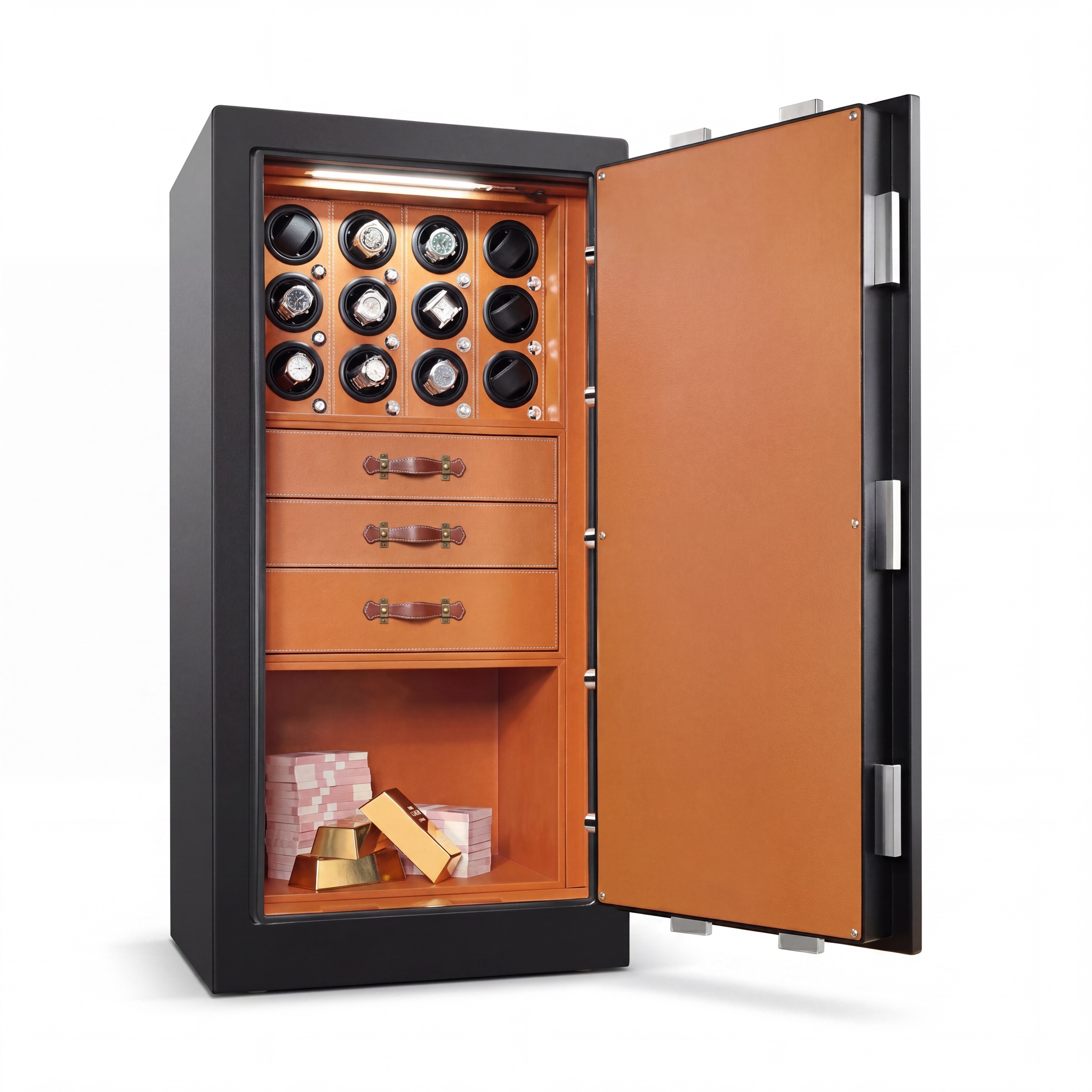
Security is measured by certified grade, not by feel. The governing standard is EN 1143-1, which rates burglary resistance in resistance units (RU) across Grades 0 to VI. The lock and locking function follow EN 1300 (classes A–B) and fire protection is covered by EN 1047. The recognised European certification bodies are VdS and ECB·S.
A well-recessed safe in a solid wall can be highly secure, but the higher your required insurance limit, the higher the grade needed — and higher grades mean thicker, heavier bodies that will not fit every niche.
"A wall safe protects through concealment; a freestanding safe protects through mass. The right answer depends on your wall and your collection."
The trade-off is rarely about taste; it is about structure and capacity. The table below sets the two formats side by side for watch collectors.
| Criterion | Wall-mounted (recessed) | Freestanding (anchored) |
|---|---|---|
| Concealment | Very high (behind art/flap) | Low to medium |
| Typical capacity | A few to ~20 watches | 30 to 75+ watches, plus winders |
| High EN 1143-1 grade | Limited by wall depth | Achievable to Grade IV–VI |
| Structural need | Load-bearing solid wall | Sound floor (200–600 kg) |
| Integrated winders | Difficult | 3 / 6 / 12 modules possible |
| Future relocation | Hard (grouted in) | Possible, since bolted |
A recessed watch safe is unforgiving of planning errors because it sits permanently in the wall. These are the points we settle before any installation.
Every Kronberg safe is tailored to your collection and your wall. After a wall assessment we define the grade, external dimensions and internal layout — leather-wrapped trays in navy, cognac or forest green, and an exterior finish in any RAL or Pantone tone. You can rehearse the layout in advance with our configurator.
Installation is available on request: our team sets the body, grouts it correctly and aligns the concealment. Because even compact, high-grade bodies quickly exceed 200 kg, weight and anchoring are no afterthought — we cover them in detail in our piece on safe weight and anchoring. If you would rather sort the fundamentals before buying, start with our guide to choosing a watch safe.
Wondering whether a wall-mounted safe suits your home? Speak with our atelier near Zürich on +41 44 974 27 19 or via the contact page — we will assess your wall and advise honestly on which format best protects your watches.
It must fully accommodate the safe body and leave enough solid material behind it so the rear panel is not a weak point. Load-bearing concrete or full-brick walls and exterior walls qualify; plasterboard and stud walls do not.
Not inherently. A wall safe protects mainly through concealment, while a freestanding safe protects through mass and a higher EN 1143-1 grade. For high insurance limits, a heavy anchored freestanding safe is usually superior.
Realistically a few up to around 20, because the wall depth limits body size. For 30 to 75 watches plus integrated winders we recommend a freestanding safe in an 85, 120 or 170 cm format.
Price depends on grade, size and interior; Kronberg freestanding safes start at CHF 12,900, while custom in-wall builds are quoted per project. We issue a firm quotation after the wall assessment.
It is possible but often constrained by the limited recess depth. For 3, 6 or 12 individually programmable winders, a freestanding safe or a Grand Cabinet is usually the better solution.
Yes, provided the safe specification matches your insured value and the safe is correctly installed in a suitable wall. VdS or ECB·S certification is the recognised proof insurers accept.
Book a no-obligation personal consultation with a Kronberg advisor. We'll guide you through every option.