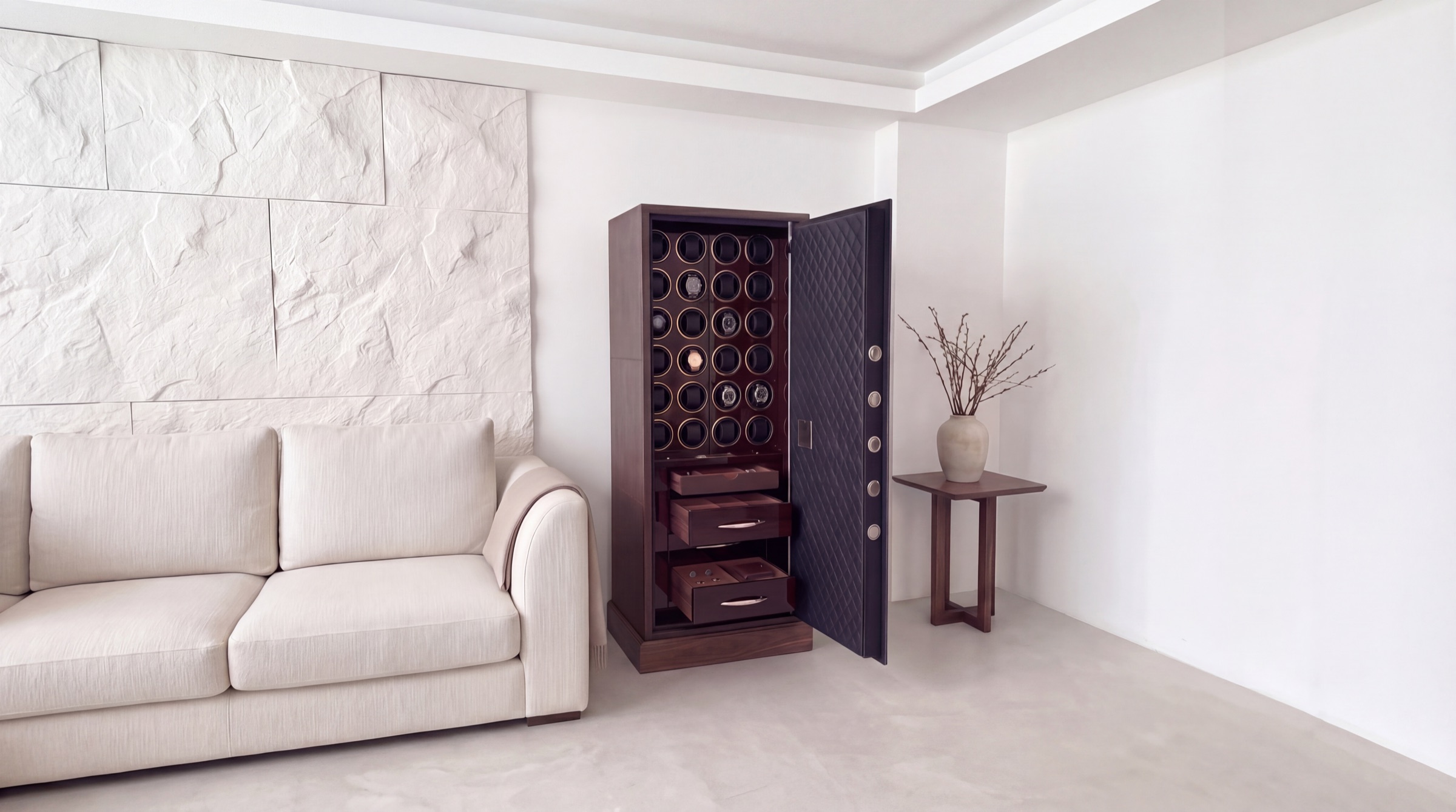
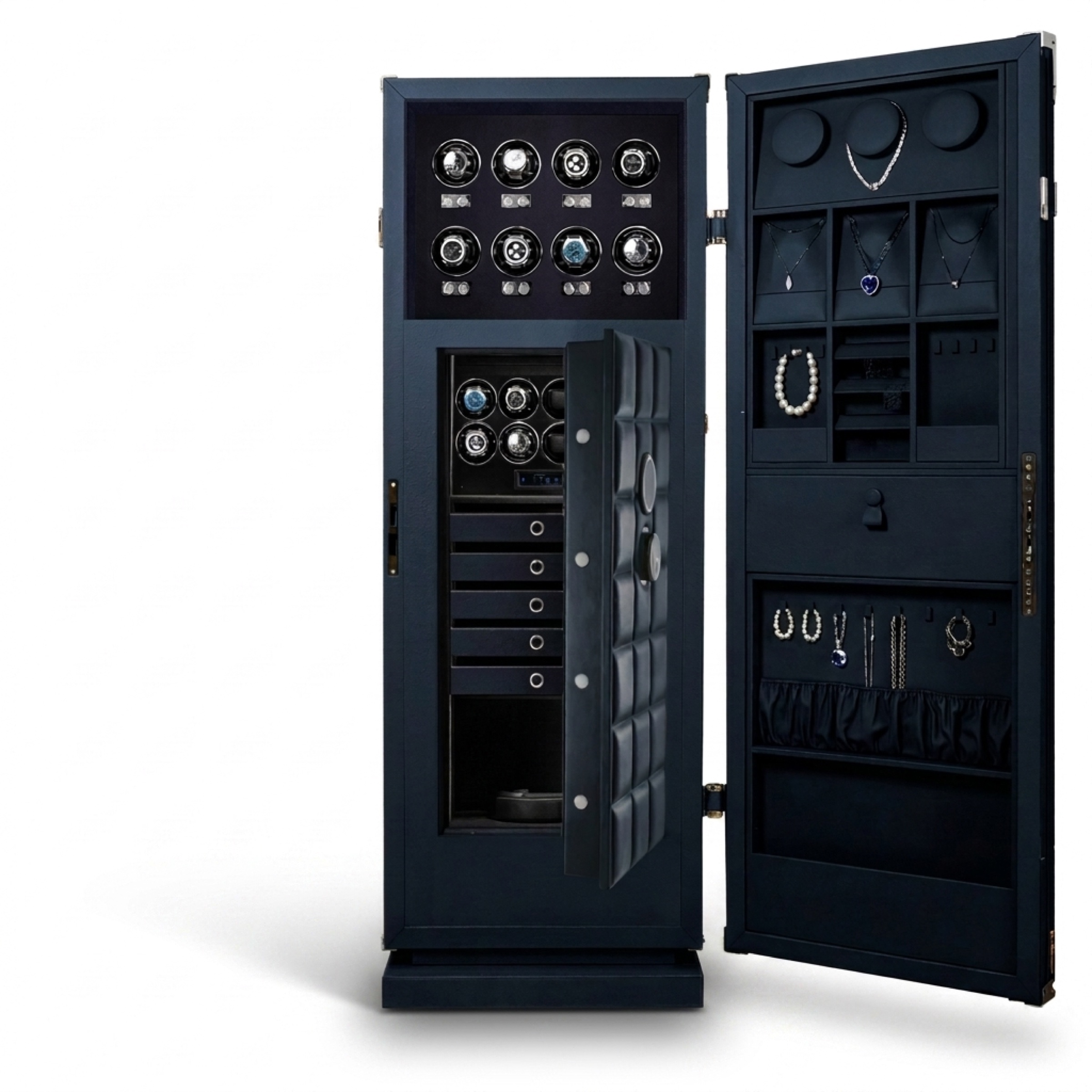
A smart safe is a watch safe whose sensors and interface connect directly to your home alarm system and your phone. Alarm integration reports door openings, vibration or tampering in real time, so a break-in is flagged the moment it begins rather than hours later when you walk through the door. A connected safe does not replace a certified steel body — it shortens the response time and turns the safe into an active part of your security setup.
At Kronberg Collection we build the sensors into the body without weakening its structure. The sections below explain what signals a smart safe produces, how a monitored safe ties into an alarm panel, and where the honest limits lie.
A safe is not smart because it has an app — it is smart because it detects events and forwards them. Three sensor types form the core: a vibration sensor (seismic) on the body, a door contact for opening and closing, and a tamper contact that fires if someone tries to pry the safe off its anchors.
These signals meet in a small control unit. It can pass voltage-free contacts to an existing alarm panel or send the alert over an encrypted radio module to a cloud service. Crucially, the body itself — steel, an EN 1300 lock and proper anchoring — remains the real barrier.
There are two proven routes. With a wired connection, the safe is integrated into a certified intruder alarm via voltage-free relay contacts; when a sensor trips, the panel treats it like any other detector and escalates to a monitored alarm-receiving centre or siren. With a standalone connection, the smart safe talks over cellular or Wi-Fi directly to an app and, optionally, to a monitoring service.
For collectors who already have an alarm, the wired option is usually the cleanest — it reuses the existing link to the monitoring centre. Anyone planning from scratch often combines both. What professional monitoring means in practice is set out in our guide to burglary protection for collectors.
A well-configured smart safe distinguishes everyday use from genuine threats. Routine events such as a normal door opening can be logged silently, while vibration detected while the owner is away escalates immediately.
"A smart safe doesn't stop an attack — it makes sure someone learns about it while it still matters."
Connectivity is an addition, not a substitute for material and certification. A vibration sensor on a lightweight furniture safe will report the attack, but it does nothing to stop a body that falls in minutes. Only the combination of an EN 1143-1-rated body, professional anchoring and a fast alert delivers real protection.
For insurers, what still counts first is the safe's resistance grade, not the app. The proof and grades typically required are covered in insurance safe requirements. Sensors can, however, help you negotiate lower premiums or higher cover limits.
| Feature | Classic safe | Smart safe with alarm integration |
|---|---|---|
| Resistance (EN 1143-1) | Yes | Yes — unchanged |
| Real-time alert on attack | No | Yes |
| Door-opening log | No | Yes |
| Link to monitoring service | External only | Built-in possible |
| Operation during power loss | Full (mechanical) | Lock yes, sensors on battery |
| Depends on internet/radio | No | Partly (standalone mode) |
The moment a safe is connected, the data link itself becomes a security factor. Serious systems encrypt communication end to end, use cellular as a fallback if Wi-Fi is cut, and actively report when the radio path is jammed — because signal jammers are now part of the professional thief's toolkit. The relevant attack routes are discussed in how safes are attacked.
We deliberately keep the sensors and their power supply separate from the lock: if the electronics fail, the mechanical or electronic closure stays fully operational. The app is convenience, not a precondition for opening.
We define the alarm integration during the design phase, not as an afterthought stuck on later. Sensors, cable routing and the interface are built in so the integrity of the body is preserved — from the compact Standard Safe to the bespoke Grand Cabinet. On request we coordinate the monitoring link with your existing installer.
In the configurator you choose size, interior and built-in watch winders; the connectivity is discussed individually. On request, our specialist team handles installation, anchoring and commissioning of the sensors on site. For a first consultation, use the contact page or call +41 44 974 27 19.
A smart safe is a safe whose sensors detect door opening, vibration and tampering and forward them through an interface to an alarm system or to your phone via an app. The body itself remains the real security barrier and is rated to EN 1143-1.
Yes. Using voltage-free relay contacts, a smart safe can be integrated into a certified intruder alarm like an additional detector, so it reuses the existing link to the alarm-receiving centre.
Yes. At Kronberg Collection the sensors have their own battery backup and are kept separate from the locking unit, and the lock opens mechanically or via battery-backed electronics independently of the mains and the network.
No. Connectivity only shortens the response time; burglary protection and therefore insurance cover still depend on the safe's EN 1143-1 resistance grade and proper anchoring.
A serious smart safe encrypts its communication, uses cellular as a fallback and actively reports radio jamming. Because opening the lock does not depend on the online connection, a cut network cannot unlock the safe.
Even for a few high-value watches, alarm integration can be worthwhile — especially with frequent absences or a second home — because a real-time alert greatly improves the chance of intervention. At Kronberg Collection the sensors can be built into the compact Standard Safe 85 cm from CHF 12'900.
Book a no-obligation personal consultation with a Kronberg advisor. We'll guide you through every option.