The ideal humidity for watch storage is a relative humidity of 40 to 55 per cent at room temperature. Within this range, mechanical movements, leather straps and gaskets all stay stable - it is neither damp enough to encourage mould and corrosion nor dry enough to crack leather or harden rubber seals. If you want to control watch storage humidity properly, the goal is to hold this band consistently rather than simply reach it once.
The safe target for storing watches is between 40 % and 55 % relative humidity. Many conservators and watchmakers aim for around 45-50 % RH as a working midpoint, because it leaves comfortable headroom in both directions.
What matters most is not the perfect instantaneous reading but stability. Large swings - say between a humid summer day and dry winter heating - stress materials more than a steady value sitting slightly outside the optimum. Good watch storage damps those swings rather than chasing a number.
Temperature is part of the picture, because relative humidity is temperature-dependent. A cool safe in a heated room can form condensation on its inner walls even when the measured humidity looks safe. That is why climate has to be considered as a whole, as we explain in our guide to the climate-controlled watch safe.
Above roughly 60-65 % RH you enter the danger zone. On leather straps and Alcantara surfaces, mould can take hold and permanently damage stitching and grain. After weeks of damp, static storage, fine white spore films are not unusual.
The effect on the movement is more insidious. Watch moisture creeps in through micro-gaps and settles on steel components. Over months this produces surface rust on springs, screws and plates - damage often discovered only at service time. Internal fogging of the crystal is another red flag: moisture has become trapped inside the case.
If you keep a larger collection, this risk deserves real attention. Our guide on how to secure a watch collection covers how climate and security work together.
"It is not the single humid day that harms a watch, but months of steady moisture nobody notices - until the crystal fogs over."
Over-dry storage is frequently underestimated. Below about 35 % RH, gaskets and rubber seals lose their suppleness. They turn brittle, shrink slightly and stop sealing reliably - the very components meant to keep water out of your watch.
Leather straps suffer too: they dry out, the fibres lose their natural oils, and fine cracks appear at the flex points. Persistently dry winter heating is the most common cause. For more on how interior materials and climate are planned together, see our notes on the leather interior guide.
| Relative humidity | Verdict | Effect on the watch |
|---|---|---|
| below 35 % | too dry | seals harden, leather straps crack |
| 40-55 % | ideal | stable protection for movement, leather and seals |
| 55-60 % | still acceptable | tolerable, but worth monitoring |
| above 60 % | too humid | mould risk, rust, fogged crystal |
The foundation is a reliable hygrometer. Even a calibrated digital unit inside the safe gives dependable readings - the key is to check it regularly rather than once a year. For passive control, two proven approaches exist:
Silica gel is cheap and perfectly adequate for smaller holdings. Its weakness is that it works in one direction only and needs monitoring: once saturated it no longer protects, and it does nothing for air that is too dry.
An active climate-control system earns its place when three things coincide: a high collection value, a location with a swinging climate, and a wish not to be forever tending packs. Instead of swapping desiccant, the system holds the target band on its own.
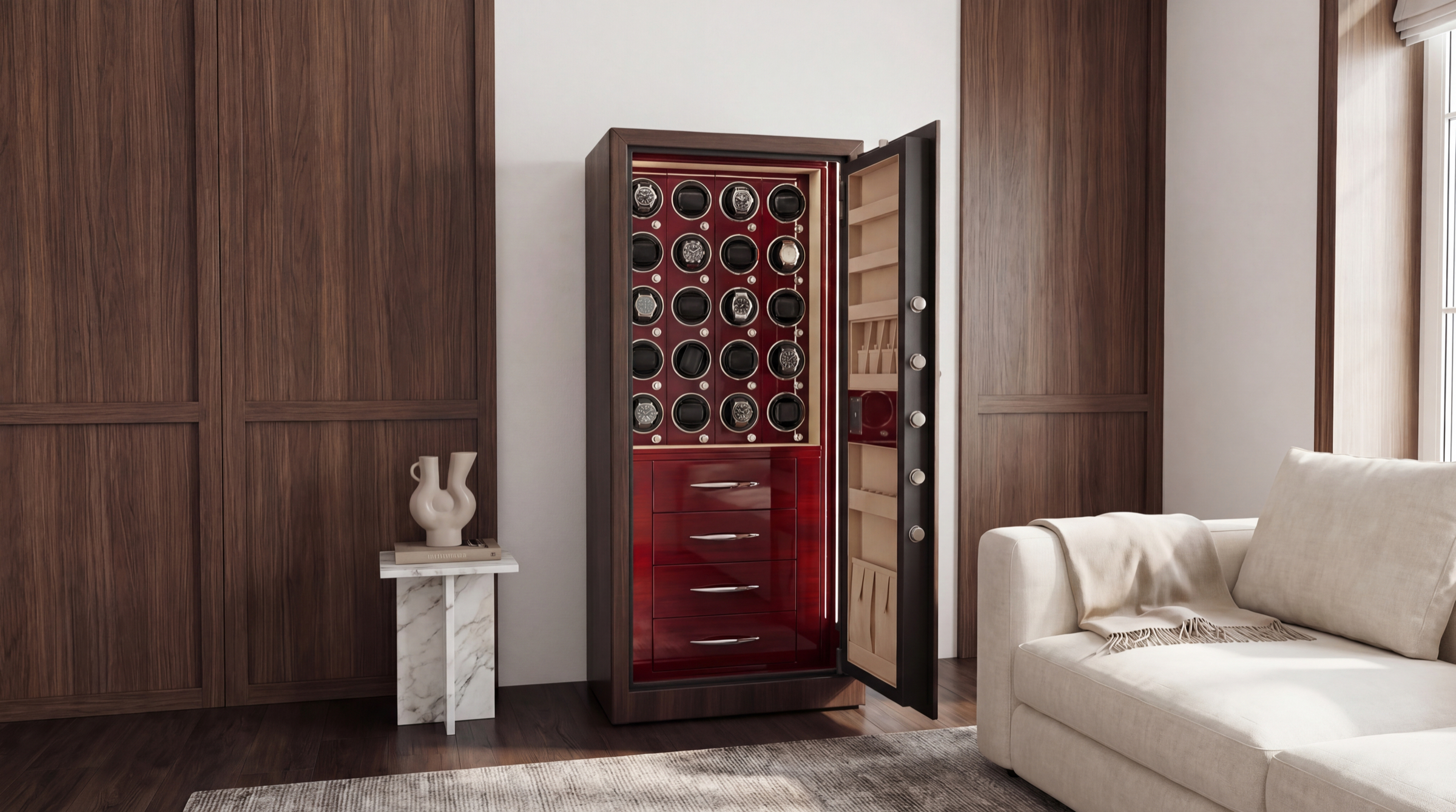
At Kronberg Collection, climate management is an optional feature on our bespoke builds. The interiors in full-grain leather, Alcantara or velour are specified so that material and climate suit one another. Our Grand Cabinets and Standard Safes can be configured accordingly.
For most collectors, a tight, well-placed safe with a hygrometer and desiccant is enough. If you are putting pieces away for years, our piece on long-term watch storage offers further guidance. Unsure which solution fits your collection? We are glad to advise you personally, and our configurator shows the full range of options.
The ideal range is 40 to 55 per cent relative humidity, with around 45 to 50 per cent as a proven midpoint. Holding that band consistently matters more than hitting an exact figure.
Yes. Above roughly 60 per cent you risk mould on leather straps and surface rust on the steel parts of the movement, and the crystal may fog from the inside. This damage usually develops gradually over weeks or months.
Yes, below about 35 per cent relative humidity, gaskets and rubber seals turn brittle and lose their sealing ability. Leather straps also dry out and develop cracks.
For smaller holdings, silica gel is cheap and effective because it absorbs excess moisture. However, it must be regenerated periodically and does nothing to help when the air is too dry.
Not necessarily. A tight, well-placed safe with a hygrometer and desiccant suffices for many collectors; active climate control becomes worthwhile mainly for high-value collections and locations with a swinging climate.
Use a calibrated digital hygrometer and check the readings regularly. Depending on your climate, manage levels with desiccant, two-way humidity packs or an active climate-control system.
Book a no-obligation personal consultation with a Kronberg advisor. We'll guide you through every option.